
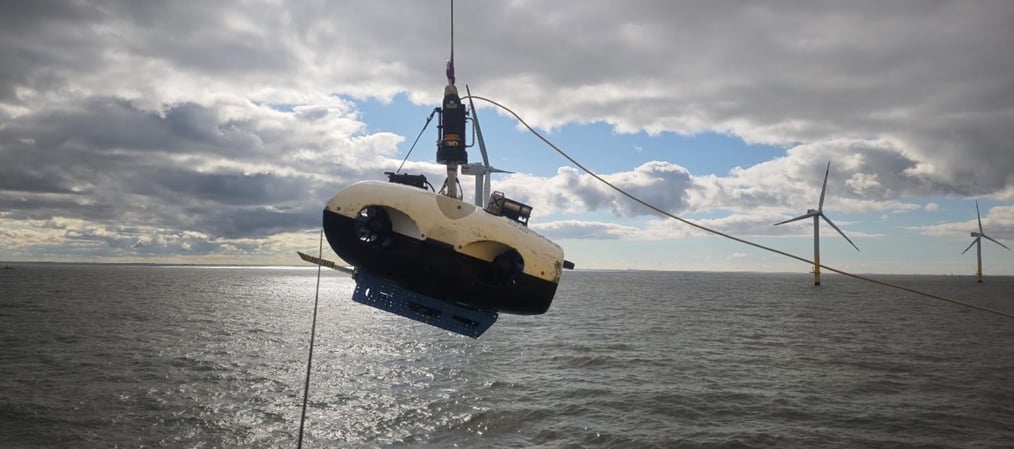
BeeX deployed its autonomous underwater inspection system as the primary platform — operating without a large support vessel and with a significantly reduced onsite crew. The mission was structured as a pilot, directly benchmarking BeeX's capability against conventional ROV performance on a live, in-service asset.
According to a cyclical maintenance program, our client required an underwater inspection campaign to assess monopile conditions, corrosion, and cable protection systems of their wind farm located within the twelve nautical mile zone of Lower Saxony. Traditionally done with conventional ROVs, the company recognized the opportunity to rethink their inspection process and was in search of a more integrated approach.
Looking ahead, the company selected BeeX as the most suitable partner to conduct their subsea inspections. This work was preceded by a trial completed by BeeX within just one month of testing, proving the unparalleled speed and precision of their technology. Following the success of their trial, the client was ready to move forward with BeeX, working on collaborations for 2026 and beyond.

Between the months of August and September, eighteen monopiles were inspected by BeeX’s drone in just 16 days. Autonomous inspection drone A.IKANBILIS was selected by the client over other traditional fuel-powered ROVs due to the vehicle’s cost-efficient, high productivity, and robust data gathering techniques. BeeX fit all inspection-required equipment in two pallets, which were deployable with a 1-ton crane from each monopile’s transition piece (TP). Using the vehicle allowed the client to deliver a lower HSE risk, higher savings for the project with additional 95% on carbon emissions against traditional ROV operations. A.IKANBILIS was deployed with two crew members, unlike traditional ROV teams that require a bigger team and larger equipment to operate. Beyond cost-savings and easy transportability, the vehicle displayed impressive current-fighting capabilities. While other vehicles of the same weight class could only handle currents up to 1 knots, A.IKANBILIS withstood currents up to 1.8 knots with its adaptive station-keeping ability. This ability greatly reduced collision risk on important assets that would cost millions to insure.
The client was impressed with the lightweight drone’s ability to navigate other offshore challenges with ease. While ROV vehicles and operators would struggle with piloting their vehicles due to poor visibility caused by silt from the tributary’s seabed, A.IKANBILIS autonomous navigated through the waters and captured highquality video footage of the inspection area, enhanced through AI and the integrated sonar map. Throughout the mission, clients were able to get a glimpse of a live feed of from autonomous drone’s camera as the vehicle performed visual checks of welds, boat landings, Impressed Current Cathodic Protection systems (ICCP), water exchange holes, and cable protection points. A.IKANBILIS carried out BSH standard asset maintenance checks to ensure the structural health of each monopile. Key structural parts were inspected as follows:
i.) Coating Inspections – done through a General Visual Inspection (GVI) of the monopile with North, South, East, West facing
ii.) Welding seams – a General Visual Inspection (GVI)
iii.) Marine growth measurements – performed per depth category (up to –4m, up to 15 m, more than –15m)
iv.) Water Exchange Holes – GVI was conducted here but not measurements
v.) Inspection of BL and ICCP – structural state of boat landing and ICCP below water was inspected via GVI, including dents, corrosion, and other damages.
vi.) Cable protection system inspections – checked GVI on cable protection systems and cable entry and exits. The route of the cable was tracked up to the burial point.
vii.) Sonar and visual scans – to measure depth, altitude, and distance from seabed touchdown
All this information was seamlessly integrated into BeeX’s Sambal, a portal that granted clients real-time access to geo-referenced data from inspection missions. From Sambal, BeeX highlighted anomalies found on seabed topography and scour conditions through 2D sonar image mosaics and 3D point cloud visualizations of affected areas. In turn, this fast turnaround in reports allowed the client to call for an immediate meeting to re-inspect urgent anomalies, proving the importance of quick, actionable insights for asset owners.
With A.IKANBILIS, the client was able to source an alternative that met all its maintenance requirements, contributing to the success of the wind farm. The company has since expressed its enthusiasm for further collaborations with BeeX, recognizing the vehicle’s potential to provide integrated, future-ready solutions for similar European windfarm projects moving forward.
Whether you're in offshore energy, defense, or coastal infrastructure, choosing autonomy
starts with a conversation.
Transforming Underwater
Capabilities at Scale
All Rights Reserved © BeeX Pte. Ltd. 2026