

A leading global renewable energy company is driving the clean energy transition through innovation and sustainability, with more than 44,000 MW of installed renewable capacity as of 2024. The company develops and operates large-scale renewable energy projects across Europe and the Americas.
BeeX partnered with the renewable energy developer at the Baltic Eagle offshore wind farm to undertake a trial of autonomous subsea inspections, aiming to reduce costs and emissions while overcoming construction-phase logistical constraints.
Through the successful pilot, BeeX proved its capability to provide these benefits to Iberdrola:
More than half of Iberdrola’s €15.5 billion investment in renewables is focused on the offshore wind projects under construction in the US, UK, France, and Germany (https://www.iberdrola.com/about-us/iberdrola-strategic-plan).
With an ambitious offshore wind expansion plan, Iberdrola seeks to identify efficiencies in costs and logistics related to the Operations and Maintenance (O&M) of these offshore wind farms.
Offshore wind farms require periodic subsea inspections. The scope of work is decided in consultation with marine insurers, governments (lessor of the seabed), Independent Verification Body (IVB) and internal asset integrity teams.
The traditional method of subsea inspection is to use Work Class Remotely Operated Vehicles (ROV) and dedicated support vessels. This traditional method requires significant manpower and heavy logistics, making it costly and unsustainable at scale.
BeeX proposed an innovation pilot to address these challenges. By leveraging BeeX’s autonomous underwater inspection technology, the innovative pilot project aimed to reduce costs, improve safety, and minimise environmental impact while maintaining reliable and consistent inspection outcomes.
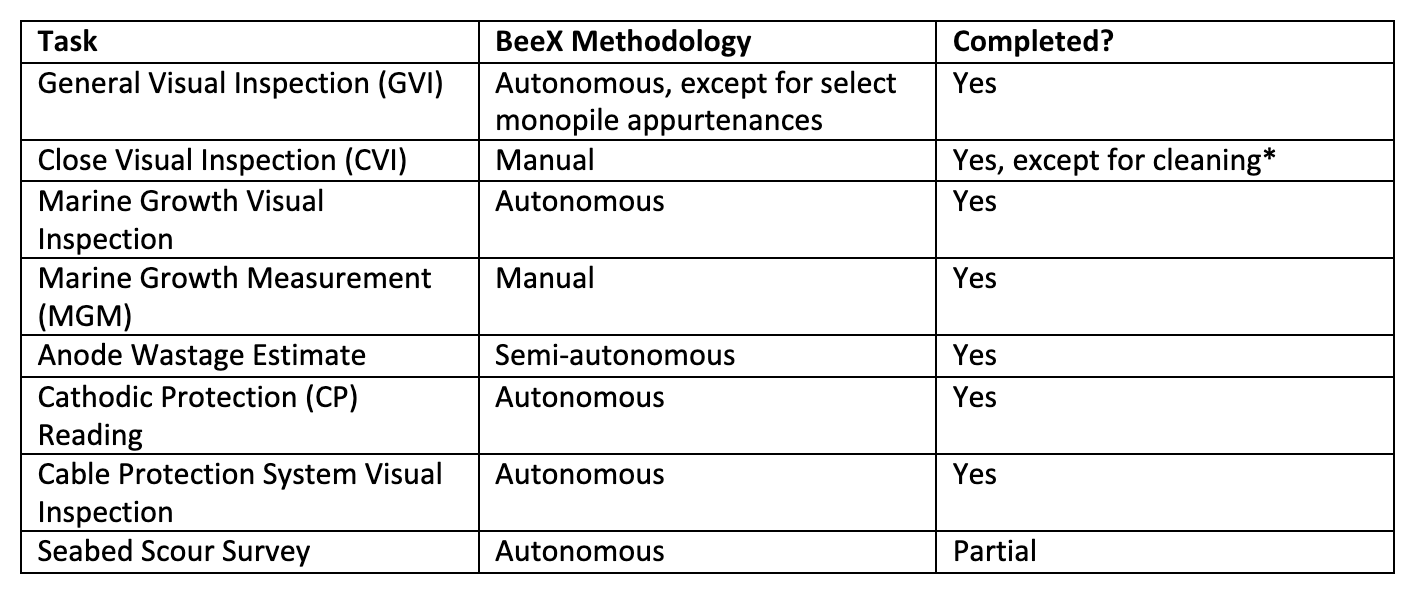
BeeX deployed autonomous underwater vehicles at the Baltic Eagle wind farm, currently under construction, to conduct subsea inspections and surveys. The scope of work was completed across multiple monopiles over multiple days, to verify reliability and repeatability.
The operation seamlessly integrated existing Crew Transfer Vessels (CTV) and turbine technician schedules with on-site logistics.
.png)
Unlike traditional subsea inspections that require a dedicated support vessel, the CTV would have been operating at the wind farm regardless of BeeX’s operation. This is akin to the difference between using a public train versus a private car.
By making use of existing resources and eliminating the need for a dedicated support vessel, BeeX reduced the carbon emissions of this subsea inspection compared to traditional methods.
Additionally, dedicated support vessels typically require a large crew, further increasing the on-site personnel risk.
As BeeX does not require a dedicated support vessel for the subsea inspection and only requires a lean team of on-site 3 personnel, the Health Safety & Environment (HSE) exposure was reduced.

Wind turbines in the construction phase present unique challenges.
Since these wind turbines are not yet operational, they do not generate any power. Therefore, any work done at the monopile of a construction-phase wind turbine must not rely on power from the turbine itself.
The traditional Work Class ROV is dependent on constant power supply as it does not have batteries on board. Thus, it necessitates extra logistics such as a dedicated support vessel to provide constant power supply.
However, BeeX's Autonomous Underwater Vehicle, A.IKANBILIS, is battery-powered. As the Crew Transfer Vessel (CTV) is akin to the “public bus” of the offshore wind farm, it would leave to attend other scheduled work once it has transported BeeX’s personnel and equipment to the wind turbine to be inspected. This is not a problem for A.IKANBILIS as it is exclusively battery-powered.
BeeX demonstrated an efficient method for mobilising onto the Transition Piece (TP) of the monopiles to conduct inspections.

The BeeX drone and equipment were packed into crates and then transferred from the Crew Transfer Vessel (CTV) to the TP using the existing davit crane on the wind turbine.
Tethered Deployment was then carried out directly from the TP. Additionally, the davit crane on site was utilised for launch and recovery of the drone for inspections of the monopile, ensuring seamless integration with on-site logistics
%20.png)
Based on the data collected on-site, autonomous flight of the BeeX autonomous inspection drone is at least 50% faster than flight by manual human control.
This mode of autonomous flight is a unique capability developed by BeeX, enabled by in-house AI algorithms, and trained on more than a decade of real-world underwater data.
Three-quarters of the tasks in the scope of work were inspected fully autonomously.

BeeX went above and beyond in this pilot by also demonstrating its wireless operations of our autonomous drone at two monopiles with Acoustic Communications System (ACOMMS).
BeeX initiated autonomous missions remotely.
BeeX successfully demonstrated wireless transmission of telemetry data, including position, depth, and altitude. In addition to telemetry, low-resolution images from the camera feed of the drone were received at a rate of one image within ten seconds. Ongoing optimisations are being implemented to enhance the reliability and consistency of this feature.
Even in its untethered mode, the autonomous inspection drone is designed to maintain its position in currents, ensuring reliable performance in untethered environments.
“BeeX found synergy with Iberdrola, a forward-thinking company with the ambition and capabilities to scale autonomous subsea inspections. The holy Trinity of Subsea Autonomy were demonstrated in this pilot, with independence from topside support of Power, Communications and Compute/Command. We are excited to continue scaling this across other offshore assets, helping them reduce costs and improve HSE.”
Goh Eng Wei
Chief Technology Officer, BeeX
The BeeX trial is one of the ways in which Iberdrola is addressing the immediate offshore operations and working towards more sustainable practices in the renewable energy industry. Using BeeX’s services, Iberdrola not only addressed the immediate challenges of scaling offshore operations but also set a benchmark for sustainable and efficient practices in the renewable energy industry.

BeeX’s unique combination of autonomous and wireless capabilities has shown the potential to redefine offshore inspections, offering unprecedented flexibility and efficiency. These capabilities demonstrate a potential path for Iberdrola and other renewable energy leaders to adopt untethered autonomous inspection technology, reducing dependence on resource-intensive conventional methods.
This pilot’s overwhelming success underscores BeeX’s potential to become an integral part of Renewable Energy companies’ O&M strategies, ensuring future wind farm operations are both cost-effective and environmentally conscious.
Whether you're in offshore energy, defense, or coastal infrastructure, choosing autonomy
starts with a conversation.
Transforming Underwater
Capabilities at Scale
All Rights Reserved © BeeX Pte. Ltd. 2026